


Between 12.12 and the Christmas and New Year rush, many Singapore warehouses move more pallets in eight weeks than in the previous quarter. Every one of those loads leaves the dock relying on a few hundred grams of film to keep it square on the pallet through forklift handling, container stuffing and last-mile transfers.
When loads start leaning or cartons slide off in transit, the instinct is to add more wraps. Often the better answer is to look at which pallet stretch film you are using, how far it is being stretched and how the wrap pattern is applied.
What film gauge actually tells you
Gauge describes film thickness, and in Singapore it is usually quoted in microns. Hand film and machine film for turntable and rotary-arm wrappers commonly run from 18 to 25 microns, with heavier gauges reserved for sharp-edged or very heavy loads.
Thickness on its own is a poor guide to performance. A well-formulated 18-micron cast film with good puncture resistance can outperform a cheaper 23-micron film made with lower-grade resin, because what holds the load is the film’s tension after stretching and its resistance to tearing at corners. Thicker film that tears at the pallet edge holds nothing. When comparing quotes, ask suppliers for the film’s recommended pre-stretch and puncture performance as well as its gauge, so you are comparing like with like.
A useful way to choose is by load profile:
- Uniform, square cartons under 500 kg: lighter hand or machine film, around 18 to 20 microns
- Mixed e-commerce parcels with uneven tops: 20 to 23 microns with a top sheet or extra top wraps
- Heavy loads over 1,000 kg, such as beverages or building materials: 23 to 25 microns
- Loads with sharp corners or protruding edges: higher gauge plus corner boards to prevent puncture
Pre-stretch is where the savings sit
Pre-stretch refers to how much the film is elongated before it reaches the load. Powered pre-stretch carriages on machine wrappers typically elongate film by 150% to 300%, which means one metre of film on the roll becomes two and a half to four metres on the pallet. Hand wrapping, by comparison, usually achieves somewhere between 50% and 100%, depending on the operator and dispenser. Stretching does two things at once. It increases the yield per roll, which brings down the cost per pallet, and it builds up holding force, because stretched film tries to recover its original length and so pulls the load inward.
There is a ceiling. Stretch a film past its rated elongation and it necks down, loses width and becomes prone to tearing at corners. Check the manufacturer’s recommended pre-stretch for the film you buy, and set the wrapper accordingly instead of running every film at the machine’s maximum. It also helps to check the carriage rollers during peak season, since worn or dirty rollers reduce the actual elongation achieved and quietly push film usage up.
Wrap pattern and containment force
Load stability depends on the total containment force applied around the pallet, which is the combination of film tension and the number of layers. A few practical rules apply during peak periods:
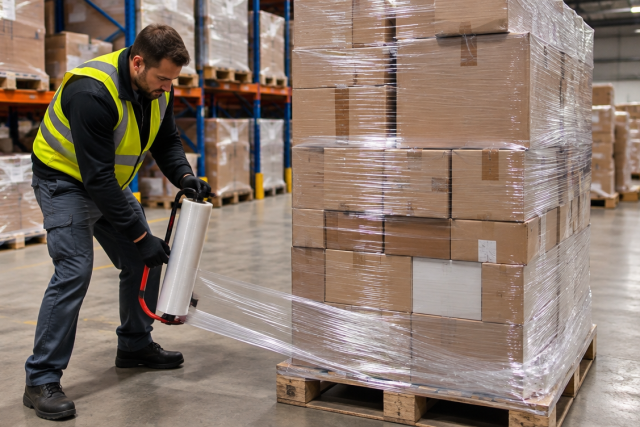
Start with three or four wraps at the base, with the film rolled or roped slightly below the pallet deck so it locks the load to the pallet itself. Overlap each revolution by about 50% as the carriage travels up. Add extra wraps at the top to stop cartons on the upper layer from shifting, and finish with a firm tail tucked into the wrap so it does not unravel on the forklift. Train temporary peak-season staff on this pattern in their first shift, because inconsistent hand wrapping is one of the most common causes of loads shifting during the busiest weeks.
For loads crossing borders by road or sea, shippers increasingly work to the load restraint principles in EN 12195-1, the European standard for calculating securing forces. Film is only one part of load restraint, but a pallet that holds its shape makes straps and blocking far more effective.
Signs your film choice is costing you
Film that looks cheap on the invoice can be expensive on the warehouse floor. Breakages during wrapping slow the line at the busiest time of year, and every collapsed pallet means repacking and, quite often, a damage claim on top. If you are seeing frequent tears, cloudy or uneven film, or loads that lean after a few hours, you are likely looking at signs that your stretch film is of inferior quality.
Run a short trial before the peak hits. Wrap ten pallets with your current film and ten with an alternative gauge or higher pre-stretch setting, then compare film used per pallet, wrapping time and how the loads look after a day in the marshalling area. The numbers usually make the decision clear.
Matching film to the rest of your packing line
Film choice does not sit in isolation. Carton quality and corner protection both affect how a pallet behaves once the film is on, and peak season is when weaknesses in any of them show up together. Reviewing your wider packaging materials before December gives you time to adjust stock levels without paying rush rates.
Preparing your warehouse for the year-end rush
A slightly lighter film run at the right pre-stretch often holds better and costs less per pallet than a heavier film stretched poorly. MOPI has supplied stretch film, tapes and packing supplies to Singapore’s logistics and manufacturing sectors since 1978. Get in touch with MOPI with your typical load weights and wrapping method, and the team can recommend a film and quantity to see you through the peak.
If you already have a wrapper on site, share its make and pre-stretch settings too, so any recommendation matches the equipment you run.