


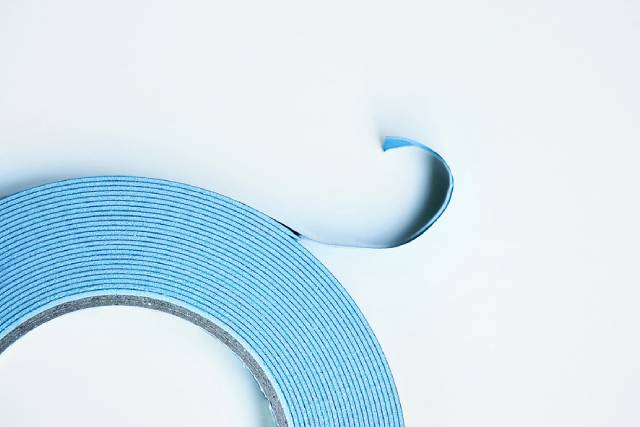
Double-sided tape looks deceptively simple from the outside. Peel, stick, done. But once you start working with it regularly, you realise that not all double-sided tapes perform the same way, and the difference often comes down to what sits between those two adhesive surfaces. The carrier, whether foam or film, changes how the tape behaves, what loads it can handle, and whether it will still be holding three months from now.
What the carrier actually does
The carrier is the layer sandwiched between the two adhesive sides. It determines flexibility, thickness, conformability, and how well the tape distributes stress across a bonded surface.
- Foam carrier, typically polyethylene or acrylic foam, provides cushioning and the ability to conform to uneven surfaces.
- Filmic carrier such as PET (polyester) or polypropylene, keeping the bond line extremely thin and dimensionally stable.
Neither type is universally better, and the wrong choice will eventually cause bond failure.
When foam carrier makes sense
Foam carrier tape is ideal when surfaces are not perfectly flat and the joint needs to absorb vibration or impact, or when slight movement needs to be accommodated. Common applications include:
- Mounting panels and signage on textured or uneven walls
- Attaching trims and finishing strips in construction and fit-out work
- Bonding materials that expand and contract with temperature changes
- Securing components in environments with ongoing vibration
Double sided foam tape also bridges surface gaps that film tape cannot. On textured, warped, or uneven profiles, a film tape contacts only the high points, while foam fills those micro-gaps and maintains consistent adhesion across the full bonded area.
Thickness varies across foam tapes, affecting both the bond gap and load-bearing capacity. Thicker foams provide more cushioning but generally hold less shear load than thinner, denser foams. For heavy-duty applications, closed-cell acrylic foam tapes offer significantly higher bond strength and better resistance to moisture and UV exposure than standard polyethylene foam alternatives.
Heat and humidity can also affect adhesive performance over time, particularly in Singapore’s climate. Understanding why tape fails in heat and humidity is useful context before committing to any bonding solution in a warm or exposed environment.
When filmic carrier is the better call
Filmic double-sided tape is superior when precision and a thin bond line matter more than conformability. Typical applications include:
- Electronics assembly and component bonding
- Graphic and print mounting onto rigid substrates
- Nameplate and label attachment
- Splicing and web joining in manufacturing processes
Dimensional stability ensures bonded surfaces stay at a fixed, predictable distance. In electronics or optical applications, even a fraction of a millimeter of movement can cause issues, and film tape removes that variable.
Because a film carrier does not deform, the force applied to the bond transfers directly through the adhesive rather than being absorbed by the carrier. For bonding rigid substrates, this directness is a clear advantage. Many film carrier tapes, particularly PET-based versions, are also optically clear, making them less conspicuous.
The trade-off is that film tape requires clean, flat, well-prepared surfaces.
Adhesive type matters too
The carrier is only part of the picture. The adhesive system affects long-term performance.
- Rubber-based adhesives offer fast initial tack and broad surface compatibility but can degrade with prolonged UV exposure or under high-temperature environments.
- Acrylic adhesives take longer to build full bond strength but deliver superior long-term durability and resistance to environmental stress.
For industrial and construction applications where longevity is the priority, acrylic systems are the sounder choice. For short-term or lower-load applications, rubber-based adhesives often provide sufficient performance at a lower cost.
A simple way to decide
Ask these two questions to guide your selection:
1. Are the surfaces flat and well-prepared? If yes, film tape is likely sufficient. If the surfaces are textured, uneven, or irregular, foam will deliver a more reliable bond.
2. Does the joint need to absorb movement, vibration, or thermal expansion? If yes, choose foam. If the bond needs to stay rigid and dimensionally precise, film is the appropriate choice.
Find the right tape for your job
Getting the specification right from the start avoids the cost of reapplication, rework, or bond failure. MOPI carries a range of foam and film double-sided tapes suited for industrial, construction, and commercial applications. Whether you are bonding lightweight trims or heavy panels, we can help you narrow down the right tape, adhesive system and thickness for your specific requirements. Get in touch with the team to talk through your requirements and find the right product for the job at hand.